Sunday, June 6, 2010

Rainbow Bridge

In 1909 two exploring parties went in search of a legendary, natural sandstone bridge in the maze of canyons that are now mostly submerged by Lake Powell. The two parties joined their efforts and found the mammoth bridge on August 14th of that year. The following year, President Taft named the arch, with a height of about 275 feet (almost the length of a football field), a national monument. Since then, thousands of people visit the arch each year--most by boat, although visitors can hike to the arch from a couple of trails starting near Navajo Mountain, but permission must be received from the Navajo Nation, since the trails are on the reservation. Loretta and Heber Black, an aunt and uncle of mine who used to work for years in schools on Indian reservations, used to live on Navajo mountain and made the hike on several occasions.

This year the bridge, located on sacred ground for a number of Native American nations, celebrates its centennial year as a national monument. On May 28th, during our trip to Lake Powell, Warren Rustand took our group through the somewhat narrow canyon leading to Rainbow Bridge. As we went he told us about Miami Vice-like races through the canyons that he has had. We had a great time visiting the place and enjoying the majestic surroundings. Some of the young men and leaders on our trip took some of the pictures included here.

These are the young men that went to Lake Powell with us.

As for what Eric Rustand is doing . . .? You'd have to ask him!

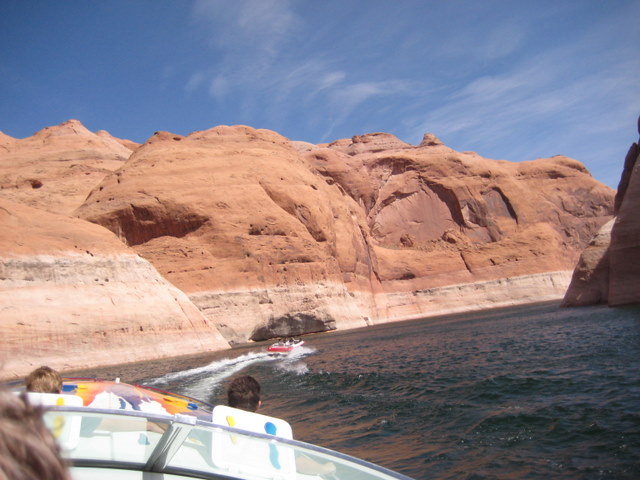
As we left we were treated to a tamed-down Miami Vice race out of the canyon. Warren gave his son, Eric, a head start before chasing him down in the speed boat.

In a part of the canyon where it widened out a little, we took the inside track and passed up the other boat.

Here is the demoralizing view from the other boat as we raced past!


Sunday, May 30, 2010

Lake Powell

This last Thursday the young men in our ward left our local church in Tucson, Arizona a little after 6:30 a.m. to head to Lake Powell. Warren Rustand, a member in our ward graciously let us use his house boat, motorboats, and jet skis that he rented.

John Wesley Powell, a Civil War veteran whose right arm had been amputated after one of the battles in which he fought, took the first organized expedition down the Green and Colorado Rivers in 1869. Nearly a century later (1956), construction began on the Glen Canyon Dam, just south of the Utah/Arizona border, to store the water flowing down the river. Seven years later it started storing the water flowing in from the Colorado River, and in 1966 it started producing electricity. It took nearly twenty years after completion to reach its full capacity in the early 1980s, but with the drought spanning several years during the last decade, the water level dropped nearly 140 feet. Since that low point, the water has risen and was only about 70 feet below capacity when we visited it this last weekend.

We had an uneventful drive of almost 400 miles as I worked with Scouts on the Pathfinding merit badge, which is only being offered this year as part of the centennial celebration of Scouting. The last time Scouting offered the merit badge was in 1952, the year it was discontinued.

After taking the house boat, motor boats, and jet skis to a beach several miles from the marina, the Scouts quickly changed into their swim trunks and slid off the slide on the back of the house boat. During the couple days that we spent at Lake Powell, the young men in our ward prepared meals, worked on Lifesaving, Swimming, and Motorboating merit badges, and had a blast going on the jet skis, riding on an inflated floating device behind the ski boat, and jumping off the rocks into the deep water below.

Yep! If one person jumps off a cliff, so does everyone else!

Even me!
Dana Willis and Scott Evans continue their tradition of doing back flips on trips they take.

It wasn't all just play--although I don't think I could convince my wife of that! Here the scouts can be seen working on the Lifesaving merit badge.

On Thursday night I rode on the yellow floating device behind the ski boat with two young men. Warren Rustand takes pride in his ability to make those riding the tube fall off. I managed to stay on for quite a while, but he finally wore me down. After falling off two or three times, I was exhausted from the constant exertion of trying to hold on--one time he even flipped us over. There was no chance to stay on. When I finally went to get on the boat, I could barely pull myself up. Jed Mayfield, one of the leaders jokingly imitated the Tyrannosaurus Rex on Meet the Robinsons, bringing his upper arms close to his body and raising the lower part of his arms into the air while saying, "I've got a big head and little arms!" I couldn't help but laugh because that is exactly how I felt.

Three of the young men who went with us gave it their best shot. The hardest part of the ride is when the boat starts to turn and the outward force begins to pull you in the direction of the turn.


Thanks to the generosity of Warren Rustand and his son, Eric Rustand, we had a great experience on Lake Powell that we otherwise would not have been able to afford, since the houseboat alone would have cost somewhere in the range of $2700 to $4000 just to rent. Thanks to the Rustands, the other leaders, and the great youth that we took up with us, it was a memorable experience for me and, I'm sure, for everyone else.

This evening shot shows the canyon walls to the southeast of where we parked the houseboat.

This panoramic picture taken by James Evans shows where we "camped." We stayed in the houseboat on the right-hand side.


Saturday, May 22, 2010

Picacho Peak

A week ago my former bishop kindly took me and three teenage Scouts for a hike up Picacho Peak. For those unfamiliar with the mountain, it is a prominent landmark mentioned in Stephanie Meyers The Host. It is also the location of the westernmost battle between Union and Confederate troops during the Civil War. It is located about 40 miles north of Tucson along Interstate-10. While I had wanted to hike the mountain several times since moving to Tucson, Arizona four years ago, I never got around to doing it. The hike was challenging for some of the youth that came with us, but they persevered and we finished the hike up the switchback trail that skirts the eastern side of the mammoth rock outcropping before going over the saddle between two peaks. It then heads down the west side of the mountain for several hundred yards before rising back up with some steep climbs where hikers cling to cable railings in numerous locations to scamper up crevices, climb steep rocks, and walk along the edge of small drop-offs.

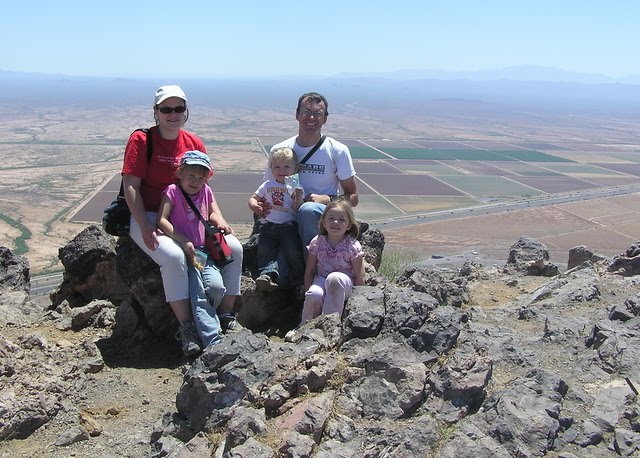
Until a day or two ago, the state park was scheduled to close, meaning the trails would be closed to the public. Thanks to fund-raising efforts by nearby residents, the park will be able to stay open beyond the original closure date of June 3rd. Since hiking the trail last week, I decided to take my family up just in case they don't get the chance to hike it again. I wasn't certain my kids would be able to hike that far, but we decided to give it a try. Gabs (6 yrs old) and Bells (4 yrs old) hiked the trail with Debs and I, and I carried Erik (2 yrs old) in a child carrier. Because of the difficulty of some parts of the climb, very few young kids make the hike. Besides our kids, the youngest person we met on the trail was six. Both Debs and I were amazed at how well Gabs, Bells, and Erik did. Just after going over the saddle to the west side we got stuck for about fifteen minutes behind a group of middle-age people who work at Raytheon. One in their group was clearly scared of heights. When he finally got down the steep stretch, our daughters climbed right down and went right past the group resting at the base in preparation of starting their ascent again. That group would occasionally pass us while we were resting and vice versa, but seeing our daughters go fearlessly up and down the climbs seems to have temporarily cured the person of his fear of heights. After that he seemed to do much better on all the the steep climbs and descents.

Gabs had no problem with the hike and led most the way. Our calling her a mountain goat just seems to have motivated her to prove that the hike was easy for her. Bells needed some help on some of the steeper parts and the latter half of the hike back due to fatigue. Debs and I did just fine until we rationed our water toward the end of the hike so the kids would have enough to drink. With about 4.5 to 5 liters of water, we knew we would be cutting it close, but we didn't really have a way of carrying much more. Gabs carried one liter, Debs carried two, and I carried the rest in the pack with Erik. As a result, both Debra and I started to cramp some toward the end of the hike--me in the shoulders because of the weight of the pack, and Debs in the calves. We probably really disappointed the half dozen vultures that were circling the area.

We saw a common chuckwalla (I think--the one we saw was a large, dark lizard with a tan tale.) We saw one last week too and one of the Scouts called it a push-up lizard because it does push-ups, but if I'm not mistaken, there are a variety of lizards that do push-ups for one reason or another. Elizabeth, if you want to add a chuckwalla to the list of lizards you have caught, come on down!

It ended up being a great hike with excellent scenery, a good workout, and a trip to a Dairy Queen located a mile or so from the trailhead. Our former bishop treated me and the Scouts to some ice cream at the Dairy Queen last week, and I decided to make it a tradition every time we do the hike. If any friends or family are in the area, you'll have to hike the trail with us.

Bells, Debs, and Gabs stop for a picture before starting the last climb to the summit.

Don't worry, she's not scared as this picture seems to imply. Bells actually sat here voluntarily and is several feet away from the cliff edge. This picture makes it look like she is much closer than she really was.

Some other hikers were kind enough to take our family picture.

This is the mischievous trio at the top! Erik had the easiest hike of the three, rocking back and forth time after time in his child carrier just to make sure his pack animal ride was balanced.

Debs grudgingly stops for yet another picture on the west side as we go down the mountain.

Debs and Bells come down a particularly steep part of the mountain.

This panoramic looks south from the summit of Picacho Peak.

Friday, April 30, 2010

A Trip Down Memory Lane

In acknowledgment of the reminiscences of a friend of mine about her childhood home in "The Valley," I decided I'd venture writing my own blog post on the subject. During the last few weeks I have heard a song on the radio that brought back some good memories from my childhood, and although the song has a melancholy tune that doesn't quite match my attitude, I think it captures the nostalgic feelings that many of us may have for the "good old days," days in which your home life protected you from many of the ugly blights of society and the bitter political wrangling over just about anything you can think of.

While life on a farm definitely had its challenges, it was a simpler life that taught the value of hard work and integrity. On a small family farm in south-eastern Idaho, my family of nine shared the responsibility of running approximately 1,400 acres of land. The chores were always suited to my age. I fed the chickens and gathered the eggs, or I would help make cracked wheat for the dogs and cats. Other chores included weeding a large garden, mowing an equally large lawn, or working in the fields. We would pull wild rye out of the crops, haul rocks off the fields, drive grain trucks, plow and weed the ground, thresh the seed grain for planting, etc. We even went hunting once a year to provide us with meat until the following hunt the next fall.

Looking back at those years, we probably could have gotten by without doing quite that much work! I can't think of a single farmer in the whole county that put as much time into hauling rocks or pulling rye as our family, but the older I got, the more I appreciated a good day's work and the the things that can be accomplished in that time.

About nine years ago, a little after my grandpa passed away, the farm that had been in my dad's family for generations was sold, the proceeds divvied up among his children as part of the inheritance. He had wanted to keep the farm in the family, but as often happens with inheritance, another small family farm became a statistic.

I will always look back on my childhood years with fondness because of the values I learned. While I would have liked to have raised my children under similar circumstances, the family farm served its purpose in my life. Physically the farm has changed since it was sold, as evidenced in this video, but in my memory, it will always be the farm where I grew up. And when times get hard I can think back to the lessons learned on the farm.


Paraphrasing the words of the Scottish poet, James Barrie, one author writes, "God gave us memories, that we might have June roses in the December of our lives."

Sunday, April 25, 2010

County Fair

For the third consecutive year we had a great evening at the Pima County Fair. I've written about our past experiences at the fair, so I've already said most everything there is to say on the subject with just a few exceptions.


We rode on many of the rides that we rode on last year--thanks to the promotional discounts they give for the rides in the weeks leading up to the fair.


One of the recurring themes of this year's experience seems to be the boar or the pig!

A nice addition to this year's fair was the petting zoo. Within minutes of our entering, one of the many goats found Deb's pant-leg and peed all over it. Truth be told, the goats were rather obnoxious. One man who was wearing a solid green shirt had the goats swarming around him, apparently thinking his shirt was food! Sorry, no pictures of this phenomenon!


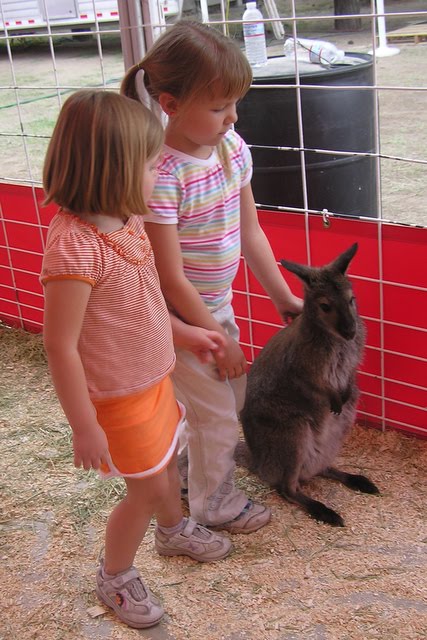
This critter was fairly skittish, but the girls managed to get close to it.


The excellent sea lion show was one of the highlights of our evening!

Can I see your ID?

A week ago after dark I noticed a few police cars parked across the street from us. I pointed this out to my wife, and she had a brilliant idea to pop some popcorn and see what neighbor was getting busted this time! When we didn't see anything going on, we went back to cleaning grapes for our trip to Mesa, Arizona the following day. A few minutes later I opened the back door to go outside and noticed that the door to the Arizona room was open, which occasionally happens when the kids play outside. I stepped inside just to make sure some thief hadn't come in our backyard to try to steal anything from the Arizona room. As I looked down the length of the room I noticed a couple of flashlights through the windows that look into the back yard. As I turned to look at them, they both came up to shine in my face. It's amazing how many things can run through your mind in a split second! Frozen in place, all I could do was say, "Hi! Can I help you?" Fortunately, they identified themselves immediately as the Tucson police.

I turned on the lights to the back yard and they informed me that a neighbor had called to report that our van door was open and it looked like someone may have broken into it. I went over and checked it out, but everything was still there. It looks like the kids left the van door open too! I closed the door and resolved to lock the back gate more often to better ensure against theft--since we have been the victims of it since moving to Tucson. It was at that point that the police officers asked me for identification. It almost made me laugh, since the thought passed through my mind to say, "Do you know who I am?", and then belligerently badger them all the way to their vehicle. Okay, so I didn't give the thought serious consideration, but the question did bring to mind the incident between Henry Louis Gates, Jr. and a Massachusetts' police officer last summer. I respect the job the police have to do and I'm sure they've probably heard enough people give them that line since the Gates' incident.

I was thankful that we had a vigilant neighbor that was willing to call the police when he saw something that looked suspicious.

My wife, who had been inside, had a different experience. When she heard me say, "Hi! Can I help you?", she thought someone hiding from the police, whose vehicles were parked out front, had hidden in our back yard. Some of the thoughts passing through her mind were, "Should I call the police? Should I close and lock the back door?" etc.

In the end, we were relieved that nothing had happened, but we found it somewhat ironic that the police had come for us and not for the drug-dealing neighbor across the street.

Sunday, April 4, 2010

Trap Restoration

The other day I was getting something out of our laundry closet when I noticed some rust sticking out of a mess of garden tools and paint cans. The rusty objects were two traps that I kept from the farm where I grew up. Like the license plates I have written about in an earlier post, I initially found these traps in the old homestead that served as my great grandparents' home before 1916. I have hung onto them with the hopes of one day being able to clean them up without damaging them too much.

I recently started looking for different rust removers that might help me clean the traps, realizing that in order to get what is probably more than a half century's worth of rust off the traps, I would have to fully submerse the traps in the solution for an extended period of time. I found most rust removers that sell in large quantities end up running about $20 per gallon, which is a little out of my budget. My wife suggested I try vinegar, so I went to the store and bought a gallon of vinegar and gave it a try. I didn't soak the first trap long enough, but it still came out better than I had expected. This picture shows one of the traps in the vinegar. The other bucket is a bucket of water. In order to keep the vinegar as clean as possible, I worked on the trap in the water bucket, only using the vinegar to soak the traps. I had to keep them submersed as much as I could since the iron would quickly begin to discolor again with rust if it started to dry. Consequently, I had to empty and refill the water bucket numerous times. When I had finished cleaning it, I had to quickly run a cloth over it to clean it and then, with another cloth covered in oil, I oiled the trap before it could rust again.


This picture shows the difference between an uncleaned trap by a cleaned one. Gabs wanted to see how they worked, so I set one of them and sprang it with the metal rod used to anchor the trap. They still work as well as ever.


I soaked the second trap in the vinegar a little longer than the first, and it cleaned up even better.


The traps' pans, which were almost completely illegible when covered in rust, revealed that the traps date back to 1917 or 1918 based on the patent dates. Debs probably thinks I'm crazy to spend so much time repairing traps that I will never use, but it's a lot of fun preserving pieces of family history!